
Introduction
More people are choosing electric vehicles as an alternative to traditional gasoline-powered cars. Unlike conventional cars, electric vehicles (EVs) use electricity to power an electric motor instead of relying on an internal combustion engine. If you are wondering how do electric cars work, the answer starts with the battery, electric motor, and other key components that work together to power the vehicle.
But how do electric cars actually work? The basic idea is simple. The battery sends electricity to an electric motor, which converts that energy into movement that turns the wheels. The vehicle relies on several supporting systems that distribute electrical power, monitor battery operation, handle charging, and help the car use energy efficiently.
This guide breaks down the way electric cars operate, covering essential parts such as the battery, electric motor, charging system, and regenerative braking in an easy-to-understand way.
For more information about our EV guides and the purpose behind MyEVCarGuide, visit our About Us page.
How Do Electric Cars Work?
The power that drives an electric vehicle comes from energy stored in its rechargeable battery. When you press the accelerator, the car’s control system directs electricity to the electric motor. The motor transforms this electrical energy into motion. This motion rotates the wheels and moves the vehicle forward.
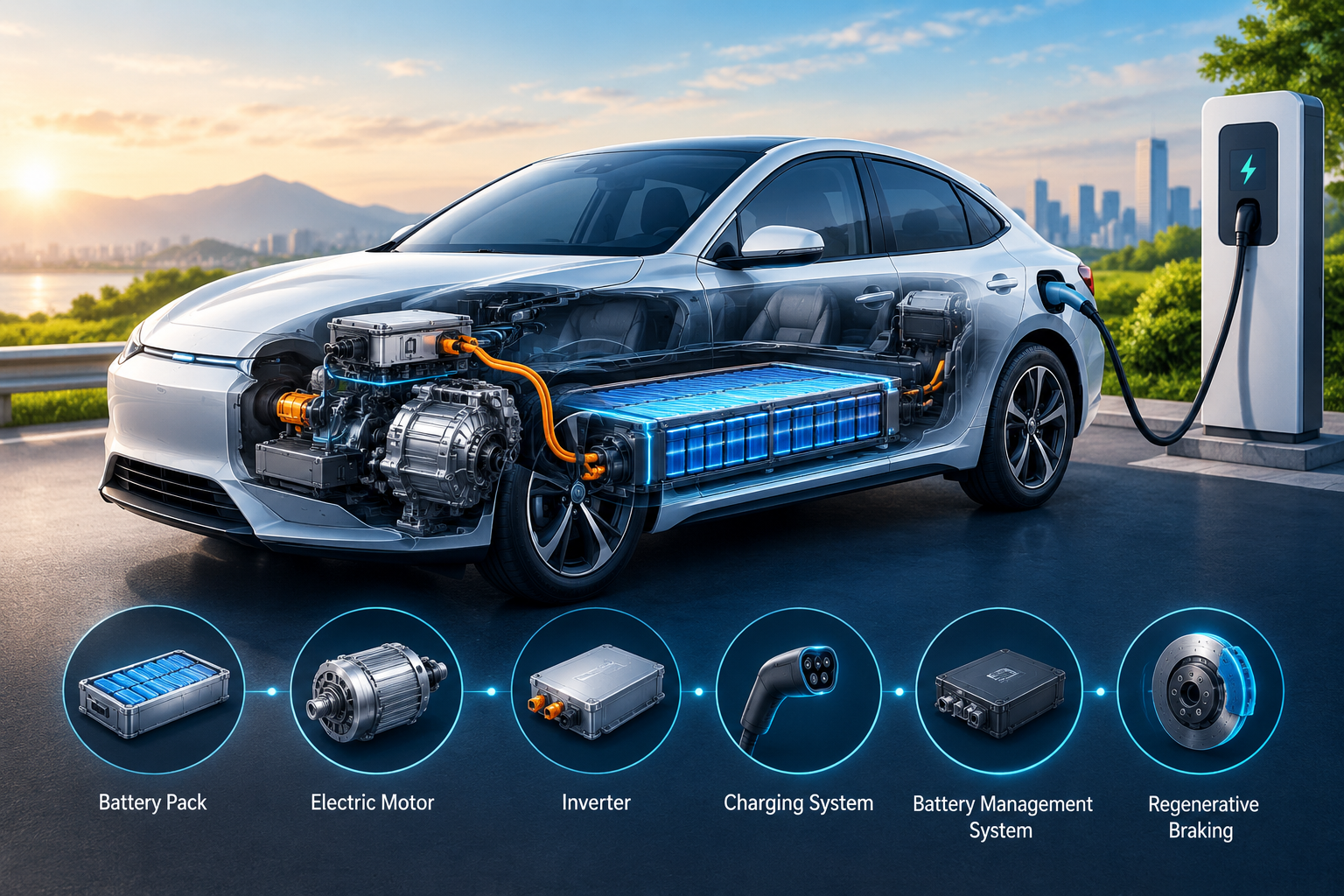
Unlike gasoline-powered vehicles, most battery-electric cars do not need a traditional engine, fuel tank, or multi-speed transmission. Instead, they use a combination of a battery pack, electric motor, inverter, onboard charger, and electronic control systems to manage and deliver power efficiently.
The battery stores the energy, while the motor uses that energy to create movement. During braking or deceleration, the car can also recover some of the energy that would otherwise be lost as heat and send it back to the battery through a process called regenerative braking.
Together, these systems allow a battery-electric vehicle to operate quietly and efficiently without producing tailpipe emissions while driving.
The Main Parts of an Electric Car
Electric cars have fewer mechanical components than traditional gasoline-powered vehicles. However, several important systems work together to make an EV move, charge, and operate efficiently. The most important components include the battery pack, electric motor, inverter, onboard charger, and regenerative braking system.
Electric Motor
The motor uses power from the battery and turns it into the mechanical force needed to rotate the car’s wheels. Electric motors can deliver strong torque almost immediately, which allows many EVs to accelerate smoothly and quickly.
Battery Pack
An EV relies on its battery pack as the primary source of stored electrical power. Most modern battery-electric cars use lithium-ion battery technology because it can store a large amount of energy while maintaining a relatively compact size and weight.
Inverter
The inverter controls how electrical power moves from the battery to the motor during vehicle operation. In many EVs, it converts the battery’s direct current (DC) electricity into alternating current (AC) for the motor and also helps control the motor’s speed and power.
Onboard Charger
The onboard charger converts AC electricity from an external power source into DC electricity that the battery can store. It also helps control the charging process by monitoring the electrical current and voltage. With DC fast charging, power flows straight from the charging station into the vehicle’s battery instead of passing through the onboard charger.
Regenerative Braking
When an electric car slows down, regenerative braking can capture some of the energy and send it back to the battery. Instead of allowing all of that energy to be lost as heat through conventional braking, the motor can operate in reverse and send some electrical energy back to the battery.
How Does an EV Battery Help Power an Electric Car?
An electric car relies on its battery pack to provide the electrical power needed for operation. The battery holds energy in chemical form and supplies it to the vehicle whenever power is needed. An EV battery pack consists of many individual battery cells that work together to store electrical energy. These cells form modules that provide the voltage and capacity the vehicle needs. If you want to know how do electric cars work, start by understanding the two main components: the battery and the electric motor.
When the driver pushes the accelerator, the battery sends electrical power through the car’s electronic control system to the motor. The motor changes this power into mechanical force, which drives the wheels and moves the vehicle forward.
Electric vehicles rely on a battery management system (BMS) to keep track of battery performance. The system monitors important conditions, including temperature, voltage, and the battery’s charge level. These systems are important for maintaining battery performance and helping protect the battery during everyday driving and charging.
An EV battery’s energy storage capacity is expressed in kilowatt-hours (kWh). Generally, a larger battery can store more energy and may provide greater driving range, although range also depends on factors such as vehicle efficiency, speed, weather, road conditions, and driving habits.
How Do Electric Cars Charge?
Electric cars need to be connected to an external power source to recharge their batteries. During charging, the charging system supplies electricity to the battery and stores it as energy for future driving. Drivers can recharge their EVs at home, at work, or at public charging locations.
Most EV charging falls into three main levels. The U.S. Department of Energy offers more details about EV charging levels and equipment. Level 1 charging uses a standard household outlet and usually offers the slowest charging rate. Level 2 chargers provide more electrical power than standard outlets, so they can recharge an EV in less time. DC fast chargers work at much higher power levels and send electricity directly to the vehicle’s battery, making them useful for quick charging at public stations.
Charging time depends on several factors, including the battery’s size, its current state of charge, the vehicle’s maximum charging rate, and the power available from the charging equipment. Some vehicles can gain a significant amount of range during a short DC fast-charging session, while slower charging methods may require several hours.
For everyday EV ownership, many drivers charge their vehicles overnight at home when convenient. Public charging stations can then provide additional flexibility for longer journeys.
Understanding how do electric cars work also means knowing how the battery receives and stores electrical energy during charging.
How Do Electric Cars Work When You Press the Accelerator?
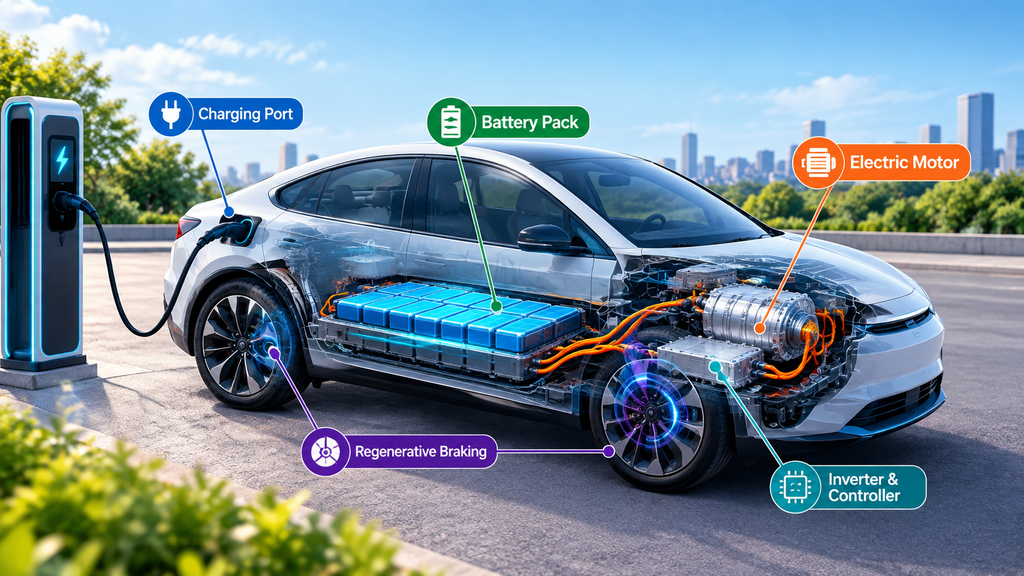
When you press the accelerator in an electric car, the vehicle’s electronic control system determines how much power is needed based on the driver’s input. The control system then regulates how much electricity flows from the battery to the electric motor.
The motor uses this electrical energy to create rotational force, known as torque. The vehicle’s drivetrain transfers this torque to the wheels, causing the car to move forward.
One key difference is how quickly an electric motor can deliver torque. An electric motor can provide substantial torque almost immediately, allowing an EV to accelerate smoothly without needing the same type of gear changes found in many conventional vehicles.
When the driver releases the accelerator, the vehicle can reduce power to the motor and, depending on the car’s settings, begin regenerative braking. This process can slow the vehicle while capturing some energy and sending it back to the battery.
How Do Electric Cars Work With Regenerative Braking?
Many electric cars use regenerative braking to capture some of the energy that the vehicle would normally lose as it slows down. During deceleration, the electric motor can slow the vehicle while reducing the need for conventional friction brakes. It also converts some of the vehicle’s kinetic energy back into electrical energy.
When the driver releases the accelerator or applies the brake, the motor can operate as a generator. The movement of the wheels causes the motor to rotate, producing electrical energy that the system can send back to the battery. This process can help recover energy and improve the vehicle’s overall efficiency.
Different EV models can provide different levels of regenerative braking. Some vehicles allow drivers to adjust the level of regeneration, while others automatically manage it based on driving conditions. Regenerative braking can also reduce the amount of work required from conventional friction brakes, potentially helping them last longer.
Regenerative braking does not recover all the energy that the vehicle uses while driving. Air resistance, tire friction, and other mechanical and electrical losses still cause the vehicle to lose some energy.
How Far Can an Electric Car Travel?
An electric car’s driving range shows the distance it can cover before the battery needs another charge. The range varies significantly between EV models because battery size, vehicle efficiency, weight, and design are different from one vehicle to another.
Real-world driving range can also change significantly depending on road and weather conditions. Higher speeds, cold or very hot weather, heavy loads, steep roads, frequent acceleration, and extensive use of heating or air conditioning can increase energy consumption and reduce the distance an EV can travel on a charge.
Battery capacity is measured in kilowatt-hours (kWh), while driving range is usually measured in miles or kilometers. A bigger battery does not always provide more driving range, as the vehicle’s efficiency also plays an important role.
For this reason, drivers should consider both the manufacturer’s estimated range and their typical driving conditions when choosing an electric car. Checking real-world range information can also help provide a more practical idea of what to expect during everyday driving.
These conditions help explain how do electric cars work under different real-world driving situations.
Are Electric Cars Better for Everyday Driving?
EVs can be a convenient choice for everyday trips when drivers have reliable access to charging. They can be used for common activities such as commuting, shopping, school runs, and local travel without needing to visit a fuel station.
Electric motors contain fewer moving components than traditional internal combustion engines. EVs also produce no tailpipe emissions while they are running. Charging an EV at home is convenient because the vehicle can receive power while it is parked.
However, EV ownership also has some considerations. Several factors can influence the EV ownership experience, including charging access, charging time, driving range, weather, and public charging availability. Long-distance trips may require more planning around charging stops.
Whether an electric car suits a particular driver depends on their daily distance, access to charging, budget, and driving needs. Understanding these factors can help buyers decide whether an EV fits their lifestyle.
Frequently Asked Questions
How Does an Electric Car Move?
An electric car moves when electrical energy reaches its motor and creates rotational force. The drivetrain carries the motor’s rotational force to the wheels, which then move the vehicle forward.
What Happens When an Electric Car Brakes?
When an EV slows down, its electric motor can work as a generator. The system captures part of the vehicle’s movement energy and converts it into electricity, which can return to the battery for later use.
Do Electric Cars Use Fuel?
Battery-electric vehicles rely on stored electrical energy rather than gasoline or diesel fuel. Their rechargeable batteries supply the electricity needed to run the electric motor.
Can an Electric Car Charge While Driving?
Simply driving an EV does not normally provide enough energy to recharge its battery. However, regenerative braking can recover some energy when the vehicle slows down and return that energy to the battery.
Do Electric Cars Have Engines?
Instead of using an internal combustion engine, battery-electric vehicles rely on electric motors to generate movement. Some other types of electrified vehicles, such as hybrids, can have both an electric motor and a gasoline engine.
What Affects an EV’s Driving Range?
Factors such as battery capacity, vehicle efficiency, driving speed, weather, road conditions, passenger or cargo weight, and use of heating or air conditioning can affect an electric car’s range.
Conclusion
A basic understanding of electric cars starts with seeing how the battery and electric motor work together. The battery supplies stored electrical power to the motor, which turns that energy into mechanical force that drives the wheels. Other components, including the inverter, onboard charger, battery management system, and regenerative braking system, work together to control energy and support efficient operation.
To understand how do electric cars work, look at how the battery sends electrical power to the motor, which then creates the force that moves the wheels.
Knowing how these EV components function helps drivers better understand charging time, battery capacity, driving range, and everyday vehicle performance. As electric vehicle technology continues to develop, improvements in batteries, charging infrastructure, and vehicle efficiency are also changing what drivers can expect from modern EVs.
Whether you are considering buying an EV or simply want to learn more about electric transportation, understanding the basics is a useful starting point.
5 thoughts on “How Do Electric Cars Work? A Simple Guide for Beginners”